


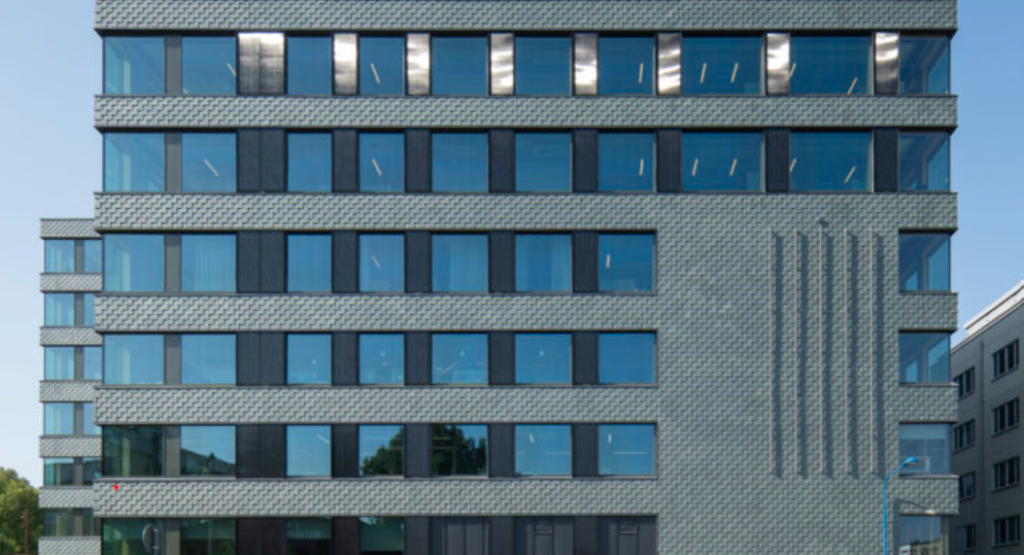
The wooden facade played a crucial role in the renovation
When the real estate company Vasakronan took on Hugin—a large office complex from the 1970s in central Uppsala—its ambition was clear: to challenge the construction industry’s conventional view of reuse. The result was Lumi, a transformed and future-proof office building where large parts of the original structure have been given new life.
The building had previously served as an office for the Swedish Food Agency, but was far from meeting today’s standards for modern workplaces. Limited flexibility, small windows, low energy efficiency, and difficulties in dividing up the space meant that demolition was long considered the only realistic option.
The concrete frame provided the foundation for a wooden addition
Instead of demolition, Vasakronan decided to explore the possibilities for renovation. By retaining approximately 80 percent of the existing concrete structure and the entire building’s foundation, the conditions were created to build on what was already there rather than start from scratch.
Three new wooden floors could be added without the need to reinforce the structure. This was made possible by replacing the previous load-bearing concrete facade with a significantly lighter wooden exterior wall clad in slate. The reduced weight meant that the addition could be constructed with minimal impact on the existing structure.
The environmental benefits were significant—the building’s carbon footprint was approximately 50 percent lower than if it had been built from the ground up.
The biggest benefit was that the foundation did not need to be reinforced. In addition, a large number of building components were reused, ranging from drywall and doors to steel beams and glass partitions.
Digital tracking of thousands of reused parts
One of the most complex aspects of the project has been managing the large number of reused products. In total, approximately 1,300 tons of material have been reused. To keep track of the flow, a digital system was developed in collaboration with the startup Cirkulära, in which all components were tagged with RFID and linked to a database.
In this way, each building component could be tracked and precisely located within the building’s BIM model.
In practice, the project has been managed using mobile 3D models, without traditional paper drawings.
The reused materials include 12,450 square meters of drywall, 1,351 square meters of brick, 6,000 square meters of suspended ceilings, and 3,000 square meters of textile carpets. Installations and fixtures such as radiators, electrical boxes, toilets, sinks, ventilation units, and refrigeration units have also been reused. In addition, the project has incorporated approximately 500 tons of recycled materials and 700 tons of renewable materials.
Nearly half of the material is recycled
In total, approximately 40 percent of the building’s materials consist of reused, recycled, or renewable resources—an unusually high percentage for an office project of this scale.
But Lumi stands out for more than just its reuse practices. Solar panels on the roof, rainwater harvesting for toilet flushing, and a sedum roof are just a few of the solutions that contribute to the building’s environmental profile. During construction, fossil-free fuels and electric-powered machinery were also used as much as possible.
As part of the renovation, the old, poorly insulated facades were replaced, and the building was equipped with modern, energy-efficient systems. The result is a significant reduction in energy consumption—from 204 to 52 kWh per square meter per year, a 75 percent decrease.
With Lumi, Vasakronan demonstrates that extensive renovation and reuse are not only possible—but can also be a competitive alternative to demolition and new construction.
Lumi Praised for Large-Scale Reuse – Sweden Green Building Council